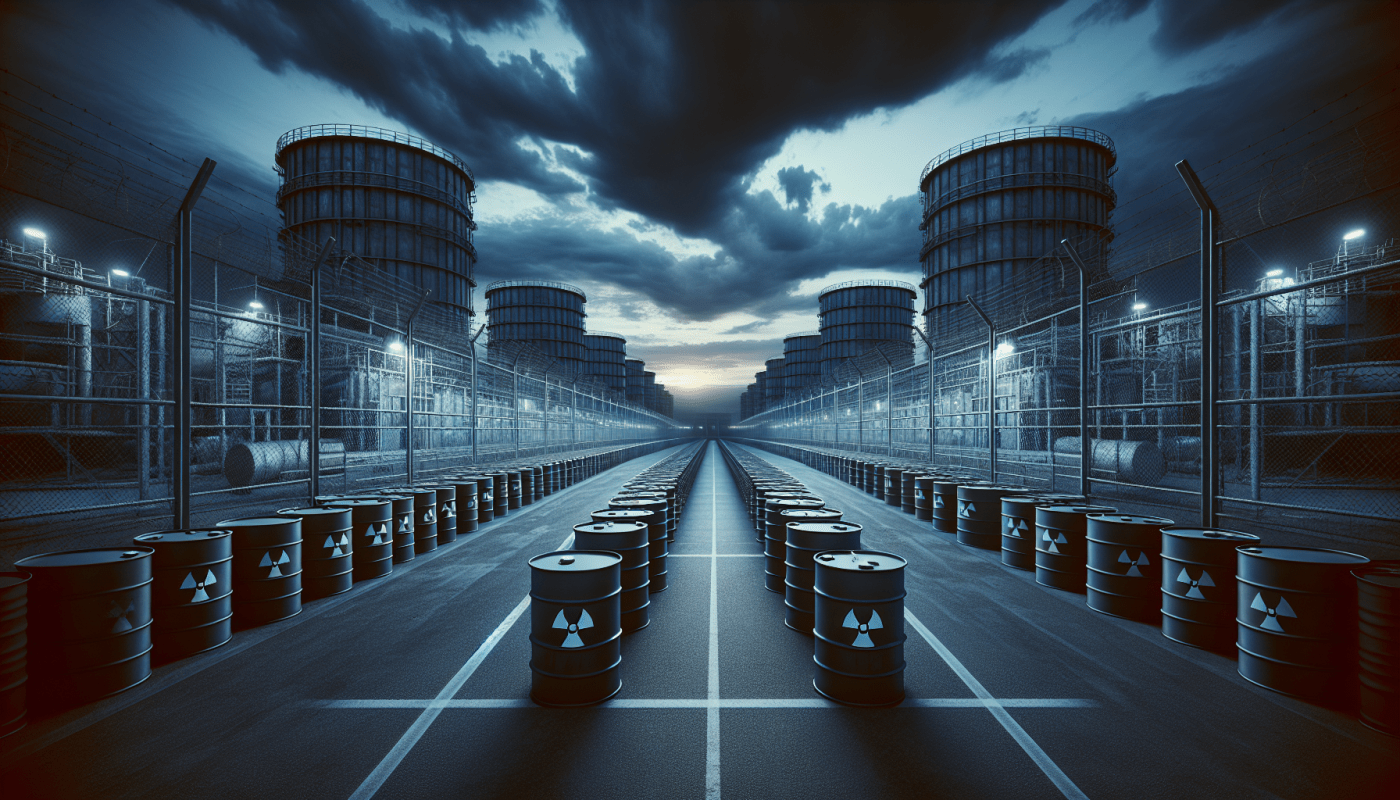
The above AI graphic is the artificial intelligence solution to the query “nuclear waste” and as such it encapsulates the bias of the uninformed. Maybe its just me but if I were an art critic I would write: “this image of dark skies, towering reactors and infinite barrels portrays the menace of the radioactive horror that threatens to overwhelm mankind.
The promise of AI was that it would do our thinking for us yet the reality is that it just regurgitates the bias of its information sources. It seems no better than The Trusted News Initiative, with acolytes CNN, BBC, ABC and CBC, at discerning the truth.
The truth is that there is great promise in that waste There is the promise of limited and controlled waste, where a 60 year lifetime’s waste from a nuclear reactor would fit in concrete containers on a football pitch, and the promise of more energy. Thermal reactors like the light water reactors used around the world use only about 2% of the available energy in reactor fuel. The development of a fleet of fast breeder reactors would be able to squeeze 60 to 70 times that energy out of the fuel. The process would burn the waste and eliminate most of the long lived radioactive isotopes. The promise is taking the potential 200+ years of uranium fuelled energy we know we have, and extending it to 14,000 years. To put that in perspective, if the pharaohs had fast reactors we would still have another 10,000 years of nuclear energy for all mankind.
Unlike fusion there are few hurdles to overcome, experimental fast reactors have been running for decades, the physics is there, now we need the momentum.
From the IAEA:
https://www.iaea.org/bulletin/when-nuclear-waste-is-an-asset-not-a-burden
What if the high level nuclear waste generated by nuclear power plants could fuel a circular economy in the energy sector? Fast neutron reactors operating in a closed fuel cycle could make that happen.
Fast neutron reactors, which use neutrons that are not slowed by a moderator such as water to sustain the fission chain reaction, offer advantages over existing thermal nuclear reactors. When operated in a fully closed fuel cycle, in which nuclear fuel is recycled and reused, fast reactors have the potential to extract 60 to 70 times more energy from the same amount of natural uranium than thermal reactors, thereby significantly reducing the amount of high level radioactive waste.
Countries are looking more and more at ways of recycling resources such as spent nuclear fuel to cleanly power their economies. Vladimir Kriventsev, Team Leader, Fast Reactor Technology Development, IAEA
“When using fast reactors in a closed fuel cycle, one kilogram of nuclear waste can be recycled multiple times until all the uranium is used and the actinides — which remain radioactive for thousands of years — are burned up. What then remains is about 30 grams of waste that will be radioactive for 200 to 300 years,” said Mikhail Chudakov, IAEA Deputy Director General and Head of the Department of Nuclear Energy.
Fast reactors were among the first technologies deployed during the early days of nuclear power, when uranium resources were perceived to be scarce. However, as technical and material challenges hampered development and new uranium deposits were identified, light water reactors became the industry standard. However, efforts are underway in several countries to advance fast reactor technology, including in the form of small modular reactors (SMRs) and microreactors (MRs).
Five fast reactors are now in operation: two operating reactors (BN-600 and BN-800) and one test reactor (BOR-60) in the Russian Federation, the Fast Breeder Test Reactor in India and the China Experimental Fast Reactor. The European Union, Japan, the United States of America, the United Kingdom and others have fast reactor projects tailored to a variety of aims and functions underway, including SMRs and MRs.
For some countries, operating fast reactors in a fully closed fuel cycle is seen as the pathway to ensuring the long-term sustainability of nuclear energy.
Russia’s Pilot Demonstration Energy Complex, which is under construction in Seversk, brings together a lead-cooled BREST-OD-300 fast reactor, a fuel fabrication and refabrication plant, and a plant for reprocessing mixed nitride uranium–plutonium spent fuel. A deep geological waste repository will also be built. The importance of this pilot project is not only to demonstrate the making of new fuel, irradiate it, and then recycle it, but to do so all on one site.
“Having the whole closed fuel cycle process on one site is good for nuclear safety, security and safeguards,” said Amparo Gonzalez Espartero, Technical Lead for the Nuclear Fuel Cycle at the IAEA. “It should also make more sense economically as the nuclear waste and materials do not need to be moved between locations — as they are currently in some countries — thereby minimizing transportation and logistical challenges.”
Running a closed fuel cycle on any scale needs fast reactors and infrastructure for reprocessing and recycling. Among other reasons, economic and safeguards aspects make it difficult to have reprocessing facilities in every country. To keep costs down, reprocessing facilities provide services to other countries, or countries share facilities.
Russia also plans to deploy a next generation 1200 MW(e) fast reactor after 2035 as part of a self-sustaining system alongside light water reactors. With help from the fast reactor, spent fuel from the thermal reactors will be reprocessed and reused, generating a final waste footprint up to ten times smaller than that of the regular nuclear fuel cycle.
Projects are advancing in other countries. China is constructing two sodium cooled fast reactors (CFR-600) in Xiapu County, Fujian province. The first unit is under commissioning and is expected to be connected to the grid in 2024. In the USA, a fast reactor project backed by Microsoft co-founder Bill Gates is under development; it will not operate in a closed fuel cycle, although the country is renewing efforts to work on closed nuclear fuel cycles and use its existing nuclear waste to develop its own supply of fuel. In Europe, the MYRRHA project in Belgium is aimed towards building a lead-bismuth cooled accelerator driven system by 2036 to test its ability to break down minor actinides as part of a future fully closed fuel cycle.
“Countries are looking more and more at ways of recycling resources such as spent nuclear fuel to cleanly power their economies,” said Vladimir Kriventsev, Team Leader for Fast Reactor Technology Development at the IAEA. “This comes at a time when technological innovations in material science, reactor physics and engineering have led to better designs, with enhanced safety features and reduced construction and operational costs that improve the economics of a nuclear plant powered by a fast reactor.”
The IAEA plays a key role in supporting the development and deployment of fast reactors by sharing information and experience through coordinated research projects, technical publications, technical working groups and conferences. The IAEA’s International Project on Innovative Nuclear Reactors and Fuel Cycles also helps the advancement of fast reactors and related nuclear fuel cycles by supporting countries in planning and collaboration.
 Scico
Scico 
Leave a comment